A Formosan serow (Capricornis crispus swinhoei) fights for life.
Stuck on a steep river bank, it eventually saves itself by swimming to safety through the raging torrent.
Taroko National Park conservation workers see it all
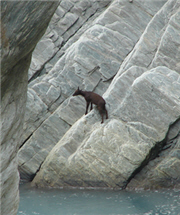 |
The Formosan serow stuck on
the steep bank |
|
A wild Formosan serow(Capricornis crispus swinhoei台灣長鬃山羊), a kind of goat endemic to Taiwan, found itself stuck on a steep marble riverbank, probably after going to the water’s edge to drink. After much hesitation, it eventually jumped in to the raging torrent and swam to the other bank before returning safely to its mountain forest home. A Taroko National Park conservation worker and substitute service draftees, who were engaging in conservation patrol training in the area, saw the whole process from the trail above the river gorge and recorded most on a video recorder. Park staff watched the trapped animal but could do nothing to help except hope for the best. Fortunately, in the end, the Formosan serow escaped through its own efforts, much to the relief of the onlookers.
On April 24, Huang Hong-da, a Technical Specialist in the park’s Tourism &Recreation Section, led six substitute service draftees allocated to work in the park to Baiyang Trail for patrol training. Much to their surprise, they saw a protected Formosan serow on the bed of the Tacih Jili River below (a tributary of Liwu River). It was attempting to return to the mountain forest, after drinking from the river, by climbing up the steep bank. However, the bank was steep and bare of vegetation, leaving the animal stuck. It moved back and forth, trying to find a way out. It was trapped for half an hour and the onlookers were very concerned for its welfare. As they watched, they filmed it with a small video camera. Finally, the animal returned to a sandbank, then leapt into the rapids. Seeing it bob in the water, the onlookers were convinced it would be swept to its death, but the hardy animal swam with all its might and eventually reached the other bank, leaving the gorge where the bank gradient was not so steep. Seeing it escape, the park employees cheered. Witnessing this wild Formosan serow’s fight for life, the substitute service draftees, who will complete their national service working in the park, were given a real-life wildlife ecology class.
A veteran park employee said that it is very rare to see large mammals in the wild in the park, apart from Formosan macaques (Macaca cyclopis 台灣彌猴), mainly because they are extremely alert and keep well away from places with human activity. At the most, people will hear their calls, find their droppings or see footprints. As to why a Formosan serow was seen near the Baiyang Trail, a place with quite a large number of visitors, he said that the animal probably didn’t feel threatened because the people were on the other side of the river. The substitute service draftees were extremely fortunate to see a wild Formosan serow after only two weeks of working in the park. They were surprised by this experience, saw the strength of wild animals’ survival instinct and also came away with a deep appreciation of the rich natural environment of the park.
The Formosan serow is distributed from low altitudes at high altitudes over a wide area. It belongs to the bovine family. Both male and female have a pair of horns. They are adept at climbing cliffs and can be said to be one of the best climbers amongst Taiwan’s mammals. The population has been affected by mountain development, destruction of habitat and excessive hunting.
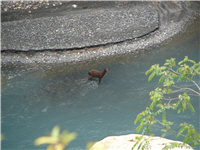 |
The Formosan serow attempts to
wade across the river.
|
|
Park Director Lin Yong-fa said that in the 21 years since Taroko National Park was established, the number of sightings of wild animals has increased significantly. A park employee once saw a Formosan serow descend to the water’s edge to drink in Taroko Gorge. In the high mountains, traces of Formosan sambar deer (Cervus unicolor swinhoei (Sclater台灣水鹿) have been seen and the call of a Formosan black bear(Ursus (=Selenarctos) thibetanus formosanus (Swinhoe台灣黑熊) has even been heard, showing that the national park’s restrictions on development and the long-term protection given to wild animal habitat has achieved results, making the value and functions of national parks clearly evident. He reminded visitors that if they encounter wild animals in their natural environment they are very lucky and he called on them to avoid disturbing them in their excitement and, also, to refrain from feeding the animals because they are capable of finding their own food in the wild.
Translated by: Kevin Lax
Source: Taroko National Park Headquarters
