On August 23rd, 2011, it was discovered that Green Sea turtles have came ashore and laid eggs in the Dongsha Atoll National Park. After more than 50 days of waiting, researchers from the Marine National Headquarters (MNPH) dug through the nests and finally determined that the little sea turtles have successfully hatched from these eggs.
Sea turtles are one of the most endangered species in the world. There are 7 types of sea turtles in the world, mostly distributed in tropical or subtropical regions. There are 2 types of sea turtles that have been documented to exist in the waters surrounding the Dongsha Atoll National Park: the Green Sea turtles and the Hawksbill sea turtle. Since the establishment of the park in 2007, the MNPH has worked closely with the Dongsha Command to promote marine resource conservation and protection of the terrestrial ecology. It was first discovered on August 23rd of 2011 that green sea turtles have came ashore to lay their eggs. Since then, colleagues from the Dongsha station have continuously monitored the hatching situation of the nest, and on October 18th signs of hatched turtles were found at the nest, proving that Dongsha Atoll National Park can be an important breeding ground for the green sea turtle.
The Dongsha Atoll National Park has vast expanses of human-interference free beaches that are best suited for breeding grounds for the sea turtles. The surrounding waters also contain vast sea grass fields and coral reefs, providing food sources for the turtles. However, in the past few decades foreign vessels have been illegally exploiting the natural marine resources in these waters, as well as catching large quantities of sea turtles. As a result, few sea turtles are witnessed to come ashore on Dongsha Island. There was only one record in 1995 when a hawksbill sea turtle came ashore to lay eggs; most of the records of sea turtle sightings were from rescue operations of sea turtles entangled in fishing nets.
Since the establishment of the Dongsha Atoll National Park in 2007, the MNPH has been working closely with the Dongsha Command to prevent foreign fishing vessels from crossing the borders and to protect the terrestrial environments of the island. On midnight of August 23rd in 2011, a green sea turtle came ashore to lay eggs on the 8th Beach of the Dongsha Island (green sea turtles are facing the threat of extinction and are an important conservation species in the world). This is the first official record of sea turtle egg-laying in the park since its establishment. The hatching period of each nest is about 50 days, but depending on the temperature of the sand the hatching time may be delayed or shortened. The estimated hatching time of this nest was October 9th, 2011. The MNPH has been monitoring the nest starting October 8th, and by the 18th the hatching of sea turtles was confirmed. The nest has survived the onslaughts from Typhoon Nesat on September 28th, Typhoon Banyan on October 10th, and the southwestern monsoons and torrential rainfalls introduced by the typhoons. Most of the eggs were successfully hatched.
The egg-hatching record is the first proof that the conservation efforts of the green sea turtles in the Dongsha Atoll National Park have been successful. This is an important first step for the conservation of sea turtles in the park, as it takes about 20 years for each hatchling to reach adulthood, and roughly only 1 in 1000 hatchlings will survive and return to this beach to lay eggs again. It is also an important first step toward the continuous support of National Park conservation.
 |
|
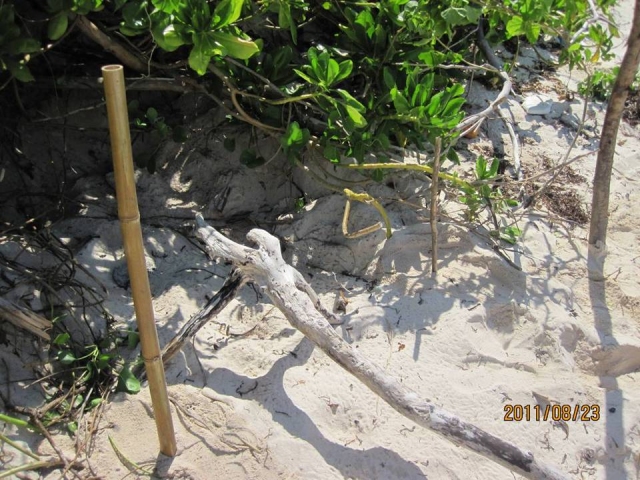
Positioning post of the sea turtle’s egg nest.
|
|
 |
|
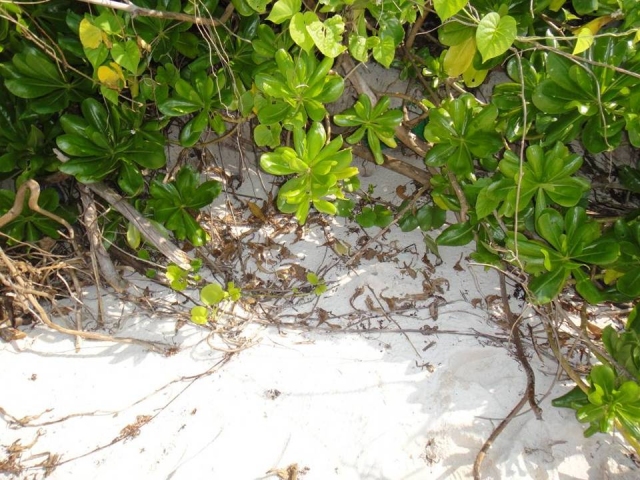
Loss of positioning post on October 13 due to
erosion of the beach sands by typhoon.
|
|
|
 |
|
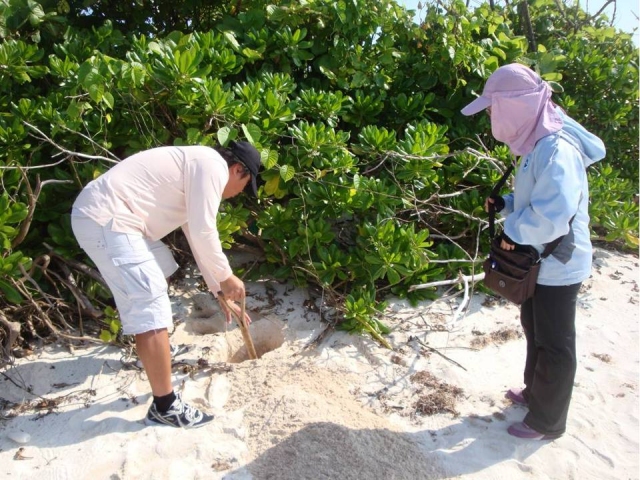
using GPS positioning and clearing of the top
layer sand with shovels.
|
|
 |
|
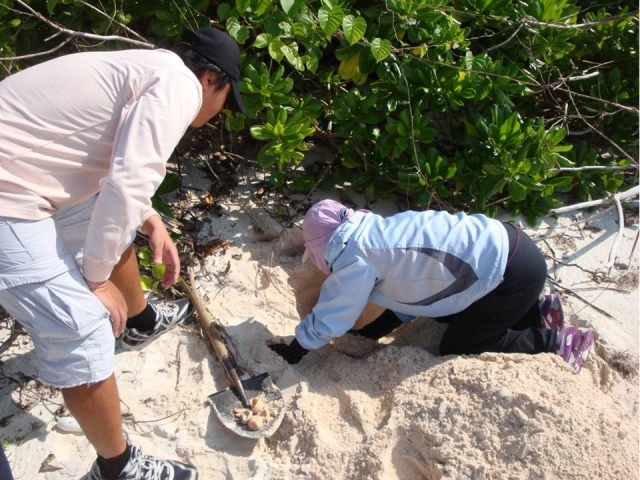
manually dig to search for sea turtle eggs.
|
|
|
 |
|
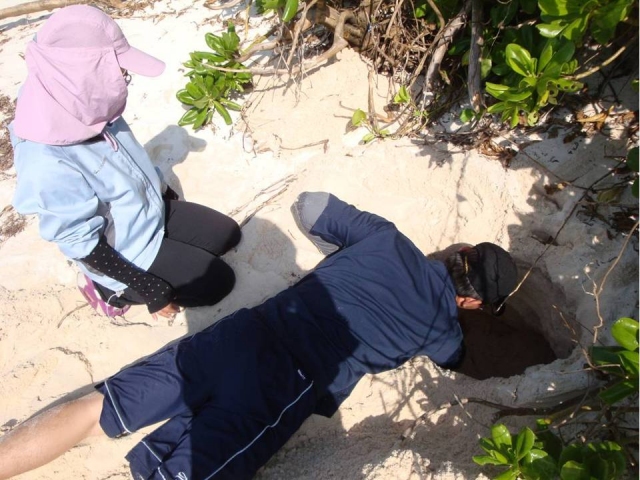
At a depth of 70cm, it was determined that
there were no longer any eggs left in the nest.
|
|
 |
|
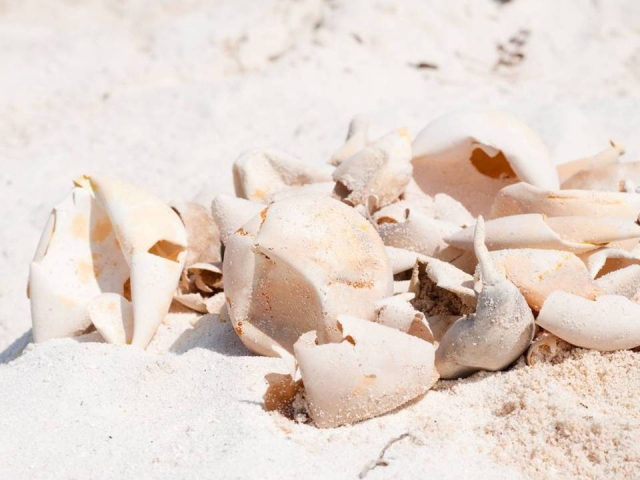
Professor Yi-Chun Cheng determined that
young sea turtles have already hatched.
|
|
|
